

From agent assist to AI voice
Call centers and service desks have always operated on levels. Tier 1 handles common questions. Tier 2 solves harder problems. Tier 3 carries deep expertise. Every level has different permissions, different knowledge, and different expectations for what they can do.
Most AI solutions ignore that reality. They introduce a single chatbot and hope it solves everything. It never does.
A better approach is to match how your call center already works. Start by augmenting agents with the right intelligence at the right moments. Then, once the foundation is solid, introduce AI agents for targeted scenarios. This two-phase approach reduces risk, improves consistency, and creates a modern operating model that scales without disrupting the customer experience.
This post walks through what that approach looks like in practice. It starts with how AI can strengthen human agents through real-time context, guidance, and automation that fits naturally into existing workflows. From there, it explores how intelligent routing and a shared knowledge layer create the foundation for safe, scalable automation. Finally, it looks at where independent AI agents and voice automation add the most value, once the operating model is ready for them.
The goal isn’t to replace people or rush to full automation. It’s to modernize the service center in a way that respects how it already works, while preparing it for what comes next.
Phase 1: Augmenting human agents
The fastest path to value is improving the experience for the people who take calls and handle messages every day. AI agents can make human agents faster and more accurate without changing the call flow.
When a conversation begins, the AI can:
- Summarize the customer history
- Identify the intent
- Surface relevant information before the agent asks a single question.
During the interaction, the AI provides suggested responses, knowledge base snippets, and policy reminders. After the call, it writes the notes, selects a disposition code, and highlights recommended next steps.
Lower handle times, improved consistency, and faster agent ramp-up come together to raise overall service quality. By extending higher-level guidance to junior staff, organizations can scale talent while preparing agents for more complex workflows.
LLMs aligned to agent levels
Not every agent has the same knowledge or permissions. Your AI shouldn’t either.
A Tier 1 LLM should provide general guidance and simple answers. A Tier 2 LLM can handle more technical scenarios and deeper troubleshooting. A Tier 3 LLM has access to the most advanced content and edge-case procedures.

Figure 1: Example architecture of AI agents supporting different Tiers of customer service
This structure mirrors the way your teams already work. It ensures that LLMs reinforce processes instead of bypassing them, and creates a clean path for growth as the system learns from real interactions.
Human feedback strengthens the entire system
Agents have become part of the improvement loop. When the AI is helpful, they confirm it. When it is wrong or incomplete, they correct it. Their feedback refines your knowledge base, tunes the LLMs, and improves routing. Over time, your agents and your AI learn together.
Intelligent routing: Sending each interaction to the right brain
Routing is one of the most underrated opportunities in the modern service center. When a customer reaches out, the first question is not “what do they want?” It is “who should handle this?” That decision determines the quality of the entire experience.
An LLM-driven router evaluates the incoming conversation. It identifies intent, complexity, sentiment, and customer profile. It can also detect risk, such as cancellation attempts, fraud signals, or issues tied to regulated domains. With that insight, the router sends the interaction to the right place.
Some scenarios go to a self-service bot. Others go to Tier 1 agents with AI support. More involved cases route directly to senior teams. In many organizations, different LLMs support each group so every conversation is matched with the right model.
Routing creates structure. It prevents simple issues from overflowing advanced queues and ensures complex issues reach the people best suited to solve them.
The knowledge layer
Your knowledge base becomes the shared brain across human and AI experiences. It should be governed, versioned, and able to serve many types of consumers.
AI Agents do best when knowledge content is clear, concise, and chunked into smaller units. When done correctly, a retrieval system can give agents and AI the same information with the same consistency. When updated, those updates are reflected everywhere automatically.
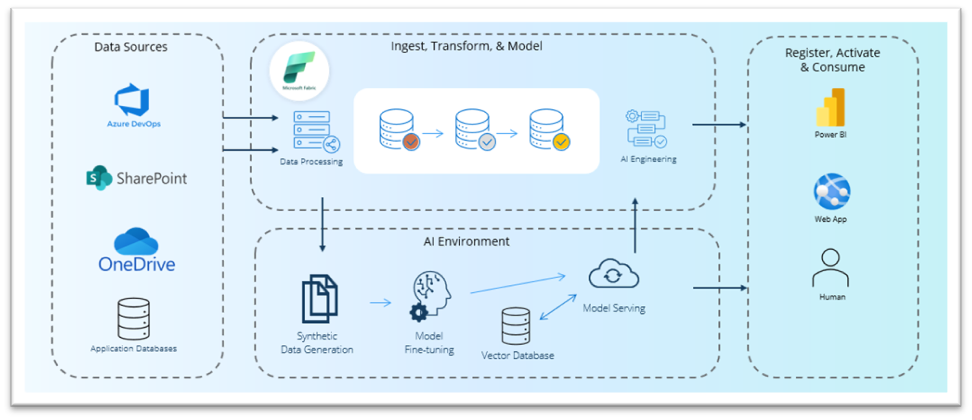
Figure 2: Example of how data moves through a call center
For advanced teams, we often fine-tune the agent against a custom dataset and then provide additional data for real-time look ups in a vector database via RAG. This allows for higher levels of accuracy of answers and performance of the agent.
Phase 2: Independent AI agents
Once your AI agents’ experience, routing, and knowledge foundation are in place, you are ready for true automation.
AI agents work best when they take on narrow, high-volume scenarios. Order lookups. Appointment scheduling. Policy questions. Address changes. These are predictable interactions where both the customer and the business want a fast answer.
These answers require real-time look up of actual data and integration with systems. Coupling AI strategy with your data strategy enables teams to create standard functions that allow agents to interact with various data systems.
The AI understands intent and takes action through your existing systems. If it encounters something unexpected, it hands the call to a human with a clean summary of what has happened so far. The transfer is warm, and the agent does not waste time asking the customer to repeat themselves.

Figure 3: Example of AI agents handling workflows
Future work often moves from text-based interaction to voice automation. Voice support should fit into your operating model, not replace it.
The same routing engine decides what the voice agent handles and what goes to a human. The same knowledge base powers its answers. The same policy layer enforces what it can and cannot do. The addition is simply a new medium for interaction, while the intelligence of the system remains the same.
A unified operating model
The real transformation is not the LLM or the AI agent. It is the operating model that brings everything together.
Humans handle nuance, empathy, and complex decision making. AI agents handle retrieval, summarization, repetitive steps, and structured procedures. Routing assigns the right brain to the right moment. The knowledge base keeps everyone aligned.
Instead of replacing agents, the AI shifts their focus to the work that matters most. And as your call center grows, the model scales cleanly without adding complexity to your front-line teams.
A practical path to an AI-enabled service center
Start with a small queue or one customer journey. Measure improvements in handle time, first-contact resolution, and customer satisfaction. Expand into additional teams once the workflow is stable. Then introduce self-service chat. After that, bring voice automation into the specific scenarios where it creates the most value.
The path is incremental and repeatable. Each step builds confidence in the system and supports the next phase of the journey.
The future of the service center is not AI or human. It is AI and human working together in a coordinated way. When every interaction is routed to the right level of intelligence, customers get faster answers, agents get a better experience, and the organization becomes more efficient.
This is the model that scales. It adapts as your products, policies, and customer expectations evolve. And it creates a foundation that is ready for the next generation of AI-driven experiences.
Move beyond chatbots to a real AI service model
See how a phased approach to AI can reduce handle times, improve consistency, and scale support without adding complexity. Reach our team at info@invisocorp.com to discuss next steps.


